
RESTAURANT ENVIRONMENTS
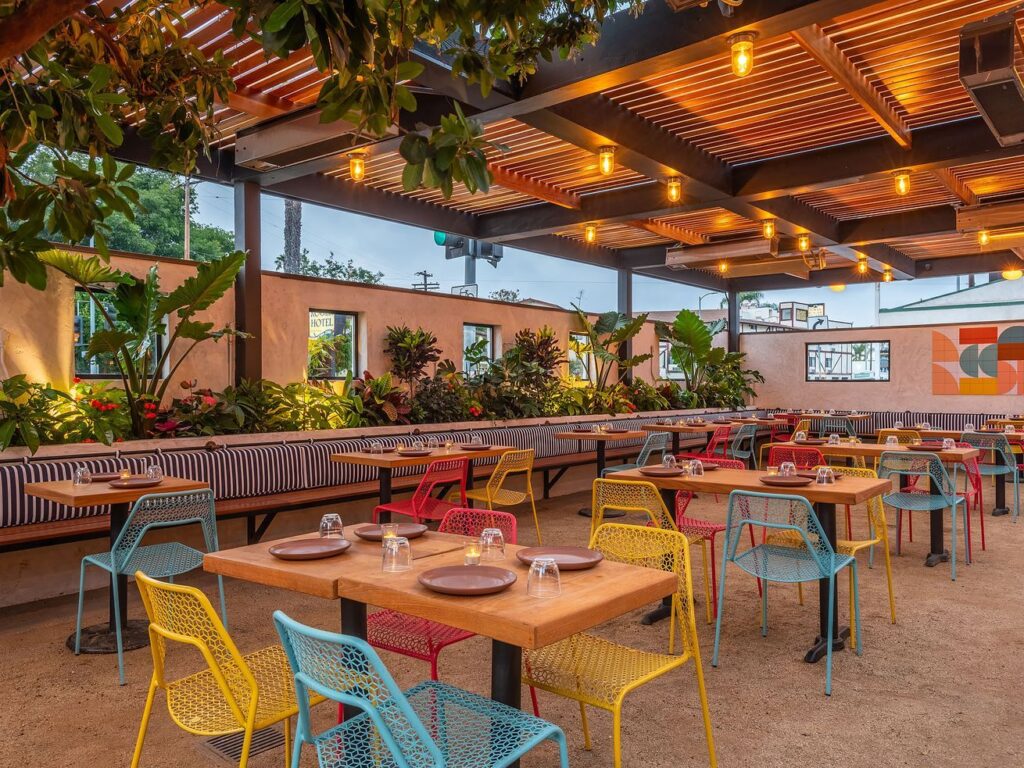
Restaurant types range from utilitarian fast-food purveyors to full-service restaurants with elaborate themes. Restaurant design encompasses a great number of issues regarding adjacencies, kitchen layouts, lighting, acoustics, and so forth. The interior designer must be familiar with each, especially with the dimensional criteria for seating layouts. Before planning the seating layout, the designer must understand the restaurant concept. The concept should define the type of dining experience offered, the intended clientele, the hours of operation, and the menu. If the restaurateur’s idea is to put the workings of the chef on display, for example, then the seating should be arranged so that the kitchen is visible from every table. Equally, the spacing between tables can have a substantial impact on the character of a restaurant. Tables closely packed will result in a loud and lively space, since patrons need to compete with their neighbors to be heard. Conversely, tables spaced far apart tend to separate diners into quieter pockets of conversation.
Types of Seating
Restaurant seating falls into three general categories: loose chairs, built-in seating (for example, banquettes), and bar seating. Seat height is typically 17 to 18 inches (432 to 57 mm) at a table or low counter. Bar seating typically ranges from 30 to 34 inches (762 to 864 mm) in height. All seats should be a minimum of 16 square inches (406 mm²). For the full-service dining experience, consider the use of padded seats and armchairs for ease of getting in and out of the seat.
Tables and Counters
In the restaurant trade, tables are known as tops. The most common sizes are two tops (seating two people) and four tops (seating four people). Beyond these sizes, tables are typically combined or expanded. Some tables have flip-up corners, which convert a square table seating four to a round table seating six people. Table height is typically 30 inches (762 mm). A square table with a minimum dimension of 36 inches (914 mm) across can accommodate four people. A square table with a minimum dimension of 24 inches (610 mm) across is acceptable for two; however, 30 inches (762 mm) is preferable. Smaller tables are acceptable when only drink service is provided. Counters range in height from 28 to 36 inches (711 to 914 mm); however, the Americans with Disabilities Act (ADA) requires that 60 linear inches (1 524 mm) of a counter be no more than 34 inches (864 mm) high to accommodate patrons in wheelchairs.
|
Shape |
Seats |
W |
L |
|
Square |
2 |
24″, 30″ (610, 762) |
24″, 30″ (610, 762) |
|
Square |
4 |
36″ (914) |
36 (914) |
|
Round |
4 |
36″–42″ (914–1 067) dia. |
|
|
Round |
6 |
42″–48″ (1 067–219) dia. |
|
|
Round |
8-10 |
66″ (1 676) dia. |
|
|
Rectangular |
4 (2 per side) |
30″ (762) |
42″–48″ (1 067–219) |
|
Rectangular |
6 (3 per side) |
30″–36″ (762–914) |
72″–84″ (1 829–2 134) |
|
Rectangular |
8 (2 per side) |
36″ (914) |
90″–106″ (2 286–692) |
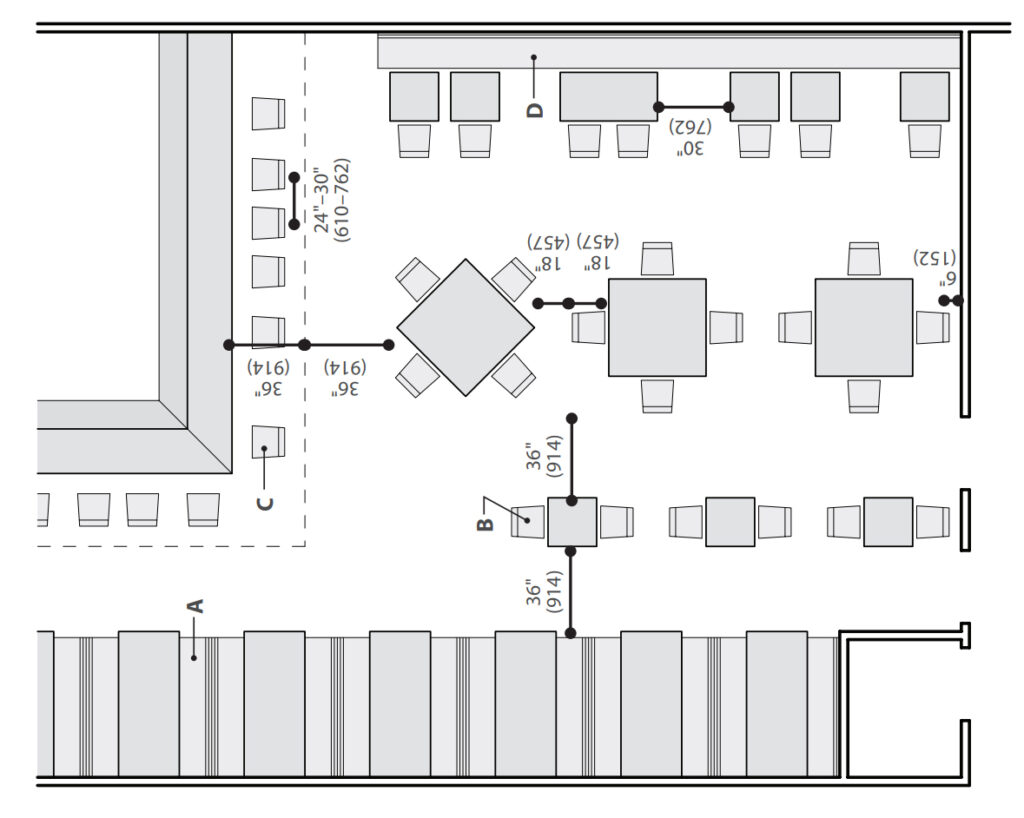
Typical Restaurant Layout
A Banquette
B Table Setting
C Bar Seating
D Wall Seating
Design Considerations
Spacing between Tables
As long as the spacing between tables meets the minimum dimensions required for an access aisle, the spacing is subjective and driven mostly by the restaurant concept. Fullservice restaurants provide more space between tables for a comfortable dining experience, while fast-food restaurants maximize the number of seats. The access aisle dimension is determined by the local building code and by the ADA, which specifies a minimum width of 36 inches (914 mm) in the access aisles and also requires that all accessible tables be located adjacent to an access aisle.
Interior Finishes
Interior finishes are the most tangible elements that a designer can use to describe the type and quality of the restaurant. Certainly, materials appropriate for the public areas will differ from those appropriate for the kitchen; but in both areas, fire-retardant materials must be utilized. In addition to the quality of the materials specified, it is important to consider their maintenance standards to ensure their suitability for the type of restaurant.
Lighting
The ambiance of a restaurant will be informed by the lighting design. Low-level mood lighting is typical of fine dining, while bright lighting offers a more casual dining experience. Over the course of a day, restaurants can change the lighting to suggest different moods. Most restaurant lighting is incandescent because of the warm tones that the lamps provide; however, fluorescent lighting is more energy efficient and may be more appropriate in the kitchen areas.
Acoustics
The acoustics in a restaurant go hand-in-hand with the concept. In some restaurants, for example, the reverberation of hard surfaces adds to the desired effect of the dining experience. There are a number of ways to control the acoustics in an environment, as long as the desired effect is understood. The simplest way to control acoustics is through soundabsorptive materials. These can range from carpet on the floor to fabric paneling on the walls to sound-absorptive tiles in the ceiling. Another strategy worth considering is to compartmentalize the restaurant into different types of rooms with different noise levels to suit the various patrons